Pneumatic conveying uses a controlled gas flow to move powders and granules through enclosed pipelines. It can reduce manual handling, connect several processing stages, and limit direct exposure between operators and bulk materials.
One of the first system-design decisions is whether the material should be transported under negative pressure or positive pressure. Both methods can move powders and granules, but they differ in system layout, pressure conditions, feeding arrangements, conveying distance, dust-containment behavior, and suitable applications.
The best choice depends on the material and process rather than one method being universally better.
Understanding Negative Pressure Pneumatic Conveying
A negative pressure system is also called a vacuum conveying system. A vacuum blower or pump is normally positioned near the downstream end of the system. It draws conveying air and material through the pipeline toward a receiver.
Because the pipeline operates below atmospheric pressure, air tends to move inward if a small leak develops. This helps reduce outward dust leakage and is one reason vacuum systems are frequently selected for cleaner material-transfer environments.
Typical material sources can include:
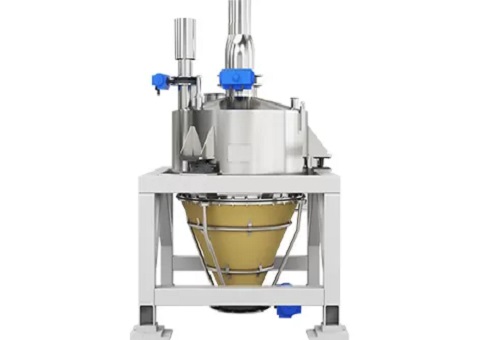
MESNAC describes its negative pressure conveying system as a dust-controlled solution for powders and granules that can be integrated into existing production layouts.
Understanding Positive Pressure Pneumatic Conveying
A positive pressure system uses a blower or compressor upstream to push conveying gas and material through the pipeline.
Material is generally fed into the pressurized line through an airlock, pressure vessel, screw feeder, or another suitable feeding device. At the destination, a filter receiver, cyclone, or process vessel separates the material from the conveying air.
Positive pressure systems are commonly selected for higher throughputs, longer conveying distances, and layouts that move material from one source to one or several destinations.
MESNAC also provides positive pressure dilute-phase systems for industrial powder and granule transfer, as well as dense-phase and nitrogen closed-loop configurations for more specialized requirements.
System Pressure and Material Movement
The primary difference is the direction of the pressure differential.
In a vacuum system, the downstream air-moving device pulls material toward the receiver. In a pressure system, the upstream device pushes material toward the destination.
This difference affects equipment placement and leakage behavior. A minor opening in a vacuum line generally draws outside air into the system, while a leak in a positive pressure line can release conveying air and potentially dust.
Neither system eliminates the need for correctly designed seals, filters, valves, and pipe connections. Poorly maintained equipment can reduce capacity and increase energy use under either pressure condition.
Dust Leakage and Workplace Cleanliness
Vacuum conveying offers an important advantage when dust containment is a primary concern.
Since the pipeline operates below ambient pressure, a small leak is less likely to discharge powder into the workplace. Coperion identifies this inward leakage behavior as a reason vacuum systems are used for dust containment and sanitary applications.
This can be valuable when handling:
However, dust containment still depends on the material receiver, filter condition, discharge valve, cleaning procedure, and maintenance program.
Positive pressure conveying can also be enclosed and clean, but the system must be designed to prevent material escape at feeding points, joints, receivers, and discharge equipment.
Conveying Capacity and Distance
Positive pressure systems can generally create a larger usable pressure differential than vacuum systems. This makes them more suitable for longer distances and higher conveying rates in many applications.
Vacuum systems are more commonly associated with shorter routes and lower or moderate capacities because the maximum vacuum differential is limited. Coperion describes vacuum conveying as particularly suitable for lower-volume, shorter-distance transfers and positive pressure conveying as suitable for longer distances and higher throughput.
These are general tendencies rather than fixed design limits. Actual performance depends on:
A conveying trial may be required for materials with uncertain or difficult behavior.
Multiple Pickup Points and Multiple Destinations
Vacuum systems are often convenient when material must be collected from several sources and transferred to one central receiver.
For example, a system may collect powder from multiple bag-unloading stations, processing machines, or storage bins. Valves can control which pickup point is active.
Positive pressure systems are commonly used when one main source feeds one or several destinations, such as transferring material from a central silo to multiple day bins or process lines.
The final routing can be more complex than these basic patterns. Combination vacuum-pressure systems are also possible when the process requires material collection followed by longer-distance distribution.
Material Fragility and Abrasion
Pressure direction alone does not determine whether conveying is gentle. Material damage is strongly influenced by conveying velocity, solids loading, pipe routing, and whether the system operates in dilute or dense phase.
High velocity can increase particle impact, fines generation, pipe wear, and temperature. Dense-phase conveying generally uses lower velocity and a higher material-to-gas ratio, making it suitable for many fragile or abrasive materials.
Before choosing a system, examine:
MESNAC positions its negative pressure system for controlled transfer that minimizes material damage while limiting dust emissions.
Filter and Receiver Requirements
In a vacuum system, the receiver is positioned before the vacuum blower so that the material and conveying gas can be separated. Filters protect the air-moving equipment and retain fine particles.
A blocked filter can reduce airflow and conveying capacity. Filter selection should consider dust loading, particle size, cleaning method, receiver volume, and discharge frequency.
Positive pressure systems also require air-material separation at the destination unless the material is conveyed directly into a process vessel. The receiver must handle the expected airflow and pressure while discharging material without disturbing upstream conveying.
Installation and Maintenance Differences
Vacuum systems can be practical where space is limited around feeding points because the blower is located downstream. They can also accept material through relatively simple pickup devices.
Positive pressure systems require an effective feeding device that introduces material into the pressurized line while limiting air loss. Rotary valves, screw feeders, or pressure vessels may be used depending on the conveying mode and material.
Maintenance planning should cover:
A system with fewer moving parts is not necessarily maintenance-free. Air leakage, worn bends, blocked filters, and unstable feeding can all reduce performance.
Which Conveying System Should You Choose?
Negative pressure conveying is often suitable when the project requires:
Dust-tight material collection
Multiple pickup points
Short or moderate conveying distances
Compact feeding stations
Transfer into one central receiver
Integration with bag-dump or suction points
Positive pressure conveying is often suitable when the project requires:
Higher throughput
Longer transfer distances
Transfer from a central source
Multiple downstream destinations
Filling silos or large process vessels
Greater pressure differential
The material should still be tested against the proposed velocity, feeding method, pipe route, and separation equipment.
Information Required for System Design
A supplier will generally need:
Material name and safety information
Bulk and particle density
Particle-size distribution
Moisture content
Flowability
Abrasion or fragility
Required capacity
Horizontal and vertical distance
Number of bends
Pickup and discharge points
Cleaning requirements
Temperature and environmental conditions
Explosion or inert-gas requirements
Conclusion
Negative pressure and positive pressure conveying systems solve different material-handling problems. Vacuum systems provide strong dust-containment advantages and flexible multi-point pickup, while positive pressure systems are generally better suited to longer distances and higher capacities.
The final choice should be based on material properties, conveying route, capacity, process layout, safety, and maintenance requirements. A properly engineered system can improve cleanliness and automation without damaging the material or creating unnecessary energy and operating costs.


 English
  中文
中文