Automated material handling improves battery and chemical manufacturing by reducing manual powder handling, controlling dust, stabilizing material transfer, and delivering raw materials to downstream equipment more consistently. The greatest efficiency gains usually come from connecting unpacking, conveying, weighing, dosing, and process control rather than automating each operation separately.
For plants handling battery powders, polymers, additives, or other bulk raw materials, this integrated approach can reduce operator intervention while improving production repeatability and workshop cleanliness.
Where Does Automated Material Handling Improve Production Efficiency?
The main advantage of automated material handling is not simply moving material faster. It creates a controlled flow from packaged raw material to the point where the material enters the production process.
In a conventional workshop, operators may need to open bags manually, pour material into hoppers, move containers between stations, and monitor feeding conditions. Each additional handling step creates opportunities for dust release, material loss, contamination, incorrect feeding, and production delays.
An automated system can instead connect raw material receiving with unpacking, temporary storage, conveying, weighing, and downstream processing.
This is particularly valuable in battery material production, where powders used for cathode and anode processing must be supplied consistently to mixing, grinding, blending, or other process equipment. Chemical plants face similar challenges when handling polymers, powders, additives, and granular materials.
Why Is Automated Unpacking Important for Powder Handling?
Automated unpacking improves both production continuity and operator working conditions by replacing repetitive manual bag opening and dumping.
An unpacking machine can receive packaged powder, open the bag, discharge the material into a controlled collection area, and prepare it for the next conveying stage. Depending on production requirements, systems may be designed for small bags, big bags, or different raw-material packaging formats.
The practical benefit becomes more obvious in high-volume production. When dozens or hundreds of bags are consumed during continuous operation, manual unpacking can become a bottleneck. Production capacity then depends partly on how quickly operators can open, empty, and remove bags.
Automation makes the feeding rhythm easier to coordinate with downstream demand.
It also allows dust extraction, screening, magnetic separation, or other treatment steps to be incorporated close to the unpacking point instead of relying on separate manual operations.
How Does Pneumatic Conveying Reduce Manual Material Transfer?
Pneumatic conveying transfers powder through enclosed pipelines using controlled airflow, allowing material to move between process stages without repeated container handling.
For battery and chemical plants, the enclosed route is especially useful where powders need to travel between floors, production rooms, storage areas, or individual processing machines.
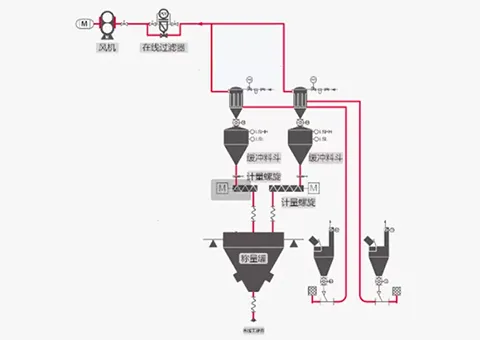
A negative pressure pneumatic conveying system creates suction within the conveying line and draws material toward the receiving unit. Because the conveying pipeline operates below atmospheric pressure, leakage points tend to draw surrounding air inward rather than pushing powder outward.
This characteristic makes negative-pressure conveying particularly useful where dust containment is an important design consideration.
It is commonly suitable for applications such as transferring material from an unpacking station to a buffer hopper, collecting powders from several feeding locations, or supplying downstream weighing and processing equipment.
However, conveying method selection should still be based on material properties. Bulk density, particle size, flowability, moisture sensitivity, conveying distance, throughput, and powder degradation risk all affect system design.
Can Automation Improve Weighing and Batch Consistency?
Yes. Material handling automation can improve batch consistency because raw material transfer can be linked directly with weighing, dosing, recipe management, and production control.
Consider a production line where operators manually open bags, transfer powder into containers, move the containers to a mixer, and then measure the required quantity. Even when procedures are well established, every manual transfer introduces another variable.
An integrated system reduces these intermediate steps.
Material can move from the unpacking machine into storage or conveying equipment and then reach a controlled weighing point according to the production recipe. Sensors, weighing devices, valves, and control software can coordinate the sequence automatically.
This matters in battery production because inconsistent raw-material dosing can affect later mixing and slurry preparation. In chemical production, inaccurate additive ratios can similarly influence processing stability and final product properties.
Automation therefore improves efficiency not only by reducing labor, but also by making material delivery more repeatable.
How Does an Enclosed System Improve Dust and Contamination Control?
Enclosed material handling limits the amount of powder exposed to the workshop environment.
Dust can appear during several stages: opening bags, emptying powder, transferring material between containers, feeding hoppers, and cleaning residual material. If these operations are handled independently, controlling emissions becomes more difficult.
Combining dust-controlled unpacking with enclosed pneumatic conveying reduces the number of open transfer points.
For powders that require tighter environmental control, the system can also incorporate dedicated dust collection, filtration, screening, iron removal, or closed-loop conveying according to process requirements.
A properly designed negative pressure pneumatic conveying system can therefore support a cleaner material route between the raw-material input point and downstream equipment.
The objective is not simply a cleaner workshop. Reducing uncontrolled powder movement also helps limit cross-contamination, recover usable material, and simplify routine housekeeping.
What Should Manufacturers Consider Before Automating Material Handling?
The most effective system is designed around the material and process rather than around individual pieces of equipment.
Before specifying a system, manufacturers should understand actual material characteristics, consumption rates, packaging formats, required batch sizes, conveying distances, available plant layout, and downstream process requirements.
Another important question is how much integration is required.
A standalone unpacking station may solve a labor problem but still leave operators responsible for transferring material to the next process. By contrast, connecting unpacking with pneumatic conveying, weighing, dosing, and central control can remove several handling steps at once.
For large battery and chemical projects, system suppliers should therefore evaluate the complete material route—from the original bag or bulk package to the equipment that consumes the material.
MESNAC develops material handling solutions covering operations such as unpacking, pneumatic conveying, weighing, dosing, mixing, and intelligent production control for industries including lithium battery manufacturing and chemicals.
Conclusion
Automated material handling improves battery and chemical manufacturing by creating a more controlled connection between raw-material receiving and production equipment.
Automated unpacking reduces repetitive bag handling, pneumatic conveying replaces many open transfers, and integrated weighing and control improve feeding consistency. When these functions operate as one system, manufacturers can reduce manual intervention while improving dust control, material utilization, and production stability.
For plants planning new lines or upgrading existing workshops, the most useful starting point is to evaluate the complete material flow rather than simply replacing one manual operation with one automated machine.
FAQs
What does an unpacking machine do?
An unpacking machine automatically opens packaged raw materials and discharges the contents into a controlled receiving or conveying system.
What materials can automated unpacking systems handle?
They are commonly used for powders and granular materials, although the design should be matched to flowability, dust characteristics, packaging, and production capacity.
What is a negative pressure pneumatic conveying system?
It uses vacuum pressure to draw powder through an enclosed pipeline toward a receiving unit.
Why use negative-pressure conveying for powders?
It helps reduce dust escape because air tends to enter the pipeline at leakage points rather than pushing powder outward.
Can unpacking and pneumatic conveying be integrated?
Yes. An unpacking station can feed directly into pneumatic conveying, storage, weighing, or dosing equipment.
Is automated material handling suitable for existing factories?
Yes, but the system should be designed around the existing layout, available space, conveying distance, production capacity, and downstream equipment.


 English
 中文